


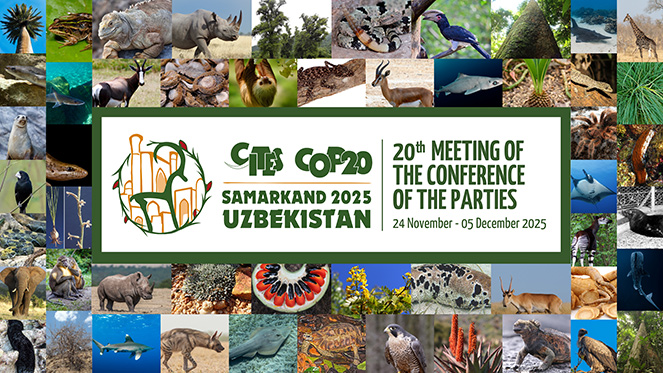
CITES CoP20 begins today in Samarkand, Uzbekistan (24 November – 5 December 2025).
CITES — the Convention on International Trade in Endangered Species of Wild Fauna and Flora (https://cites.org) — is turning 50 this year. CoP20 simply means the 20th meeting of the Conference of the Parties, the gathering where 183 signatory countries debate, adjust and vote on wildlife-trade rules.
What drew my attention this year is the fact that, after half a century of CITES, proposals and discussions about reopening trade in ivory and rhino horn are once again on the agenda.
I genuinely don’t understand how, in 2025, this is even being discussed. And I still struggle to understand the basic premise behind CITES — namely, that regulating trade in endangered species is somehow supposed to help protect them. To me, elephants, rhinos and all other wild beings have the same right to live safely on this planet as we do. Treating them as commodities feels deeply wrong.
Yet at the same time, I know we live in a human world shaped by politics, economics and power — so I want to understand what CITES actually is, what it was originally set up to do, and whether its design can genuinely protect endangered species in today’s world. I don’t know yet whether the system works, can work, or was built on assumptions that no longer hold. My hope is that by the end of this series, I’ll understand the convention more clearly and be able to make sense of its role.
For context: many people assume CITES is an animal-protection organisation. It isn’t. It was founded in the 1970s as a trade-regulation system, not a conservation agency. At that time, international wildlife trade was rampant and unregulated, and commercial exploitation was pushing many species towards extinction. The idea behind CITES was to restrict and control this trade, not to end it, in order to prevent further collapse.
I’ve been following Lynn Johnson’s work for many years, starting with her groundbreaking initiative Breaking The Brand, which developed targeted demand-reduction campaigns for rhino horn consumers in Vietnam. That project showed how demand for wildlife products is deliberately shaped and marketed. In 2017, Lynn and her partner Peter expanded this work into Nature Needs More, which builds on BTB but looks at the entire wildlife-trade system — from legal and illegal trade to supply chains, global luxury markets, behaviour change strategies, and the structural weaknesses inside CITES itself. Her analysis often challenges long-held assumptions in the conservation sector, and her work has made me realise how much of this system I never fully understood.
This blog post will become a living, evolving piece.
And in a way, the process itself is a learning journey for me too. As I work through the seven CITES@50 Reality Checks, I’ll add each new section below. This isn’t just a writing project; it’s me trying to understand an incredibly complex system one step at a time — a system that affects the lives of tens of thousands of species.
CITES shapes global wildlife policy in ways most people never see. Understanding its strengths — and its failings — is essential if we want a future in which endangered species are treated as more than commodities, and where “protection” truly means protection.
Photo credit: CITES / https://cites.org
Table of Contents — CITES@50 Reality Checks
- Reality Check 1: CITES is Broke
- Reality Check 2: Sustainable Use Model Remains Unproven
- Reality Check 3: CITES System Stuck in the 1970s
- Reality Check 4: CITES Trade Measures Never Enforced
- Reality Check 5: CITES Must Modernise or Go
- Half-Way Through CITES CoP20 — Quick Update
- Reality Check 6: CITES Must Not Be Captured by SULi
- Reality Check 7: The CITES Failed 2030 Strategic Vision
CITES@50 Reality Check 1: “CITES is broke”
This first Reality Check from Lynn Johnson looks at the financial structure of CITES. Since funding underpins any organisation’s ability to function, it’s striking that Lynn begins her series here — suggesting that the question of money may be more central to CITES’ challenges than many people realise.
For 2025, CITES requires USD 6.6 million to function.
Only about half of that — USD 3.3 million — has actually been paid by member countries.
And this is not the only issue: there is still USD 1.4 million in unpaid contributions from previous years, money that CITES was supposed to receive but never did.
In other words, the convention responsible for overseeing a global legal trade worth hundreds of billions doesn’t even have access to the full budget it needs to perform its basic functions.
The EU’s legal wildlife imports alone are worth around EUR 100 billion per year.
After seafood, the luxury markets — fashion, furniture, décor — are the largest consumers of wildlife “raw materials”.
The biggest financial beneficiaries are high-income regions: Europe first, then North America, China/Hong Kong, and Japan.
Yet the system that supposedly ensures this trade is legal, traceable, and sustainable is chronically underfunded, dependent on member country contributions that rarely arrive in full.
Lynn summarises the core absurdity clearly:
“A regulator is only as effective as the funds it has to implement its mandate.”
I was surprised to learn that in other sectors, this imbalance would be unthinkable.
Pharmaceutical companies, for example, must finance the regulators overseeing them.
But in wildlife trade, luxury industries that rely on wild species for profit don’t contribute to the regulatory system that enables this trade to continue.
Lynn emphasises that CITES’ own reports acknowledge ongoing financial constraints that limit the Convention’s ability to deliver its mandate.
This raises a basic structural question:
How can CITES be expected to ensure sustainable or controlled trade when it can’t even finance the monitoring required to carry out its most basic functions?
My personal view
If powerful industries profit from using wild species as commodities, then they should also contribute to the cost of regulating that trade. Leaving regulation entirely to member countries — many of whom struggle to meet even their basic contributions — feels outdated and fundamentally unfair.
As the saying goes, “money makes the world go around”, and I can’t help but wonder how much this chronic funding crisis shapes what CITES can and cannot do. I’m working through the Reality Checks one by one, and I’m curious to see whether this structural weakness helps explain why the convention’s effectiveness is being questioned by so many.
➡️ Read the full article here:
https://natureneedsmore.org/cites50-reality-check-1-cites-is-broke/
The basic premise
This Reality Check examines the idea at the core of CITES: “sustainable use”. After 50 years, there is still no evidence that the wildlife trade regulated by CITES is actually sustainable — and none of the parties involved seem interested in finding out. Not governments. Not industries. Not even conservation NGOs or academics.
Why no one tests whether the trade is sustainable
- Businesses avoid genuine validation because it could restrict access to the wild species they use as “raw materials”.
- Governments avoid it because true sustainability checks would challenge the “growth at all costs” mindset.
- Many conservation NGOs and academics publicly support the “sustainable use” model without ever demanding evidence for it.
Scientific reviews back up this lack of scrutiny. A 2024 global study scanned more than 30,000 papers and found only five that could even be used to analyse sustainable use. Another major meta-analysis in 2021 found no quantified example of genuinely sustainable trade.
Despite this, the term continues to be repeated as if it were established fact.
The NDF problem: assumptions instead of evidence
CITES relies on something called Non-Detriment Findings (NDFs) to claim that exports won’t harm a species. These sound reassuring — but in practice, they have no binding standards, often lack basic population data, are rarely published, and in some countries are even prepared by industry itself.
With almost no central review, the system rests on assumptions rather than evidence.
Lynn Johnson describes the consequence with sharp clarity:
“Sustainability without the corresponding transparency is just an ideology.”
My personal view
If “sustainable use” is the foundation for legal wildlife trade, then trade should only occur once transparent, independently verified data exists. Without baseline population data and standardised assessments, sustainability can’t be measured — and allowing trade without that information simply isn’t credible.
I’m curious to see how this structural flaw links to the issues raised in the other Reality Checks. If the very model at the core of CITES has never been validated, what does that mean for its ability to protect species in the real world?
Read the full article here:
https://natureneedsmore.org/cites50-reality-check-2-sustainable-use-model-remains-unproven/
CITES@50 Reality Check 3: The CITES System Is Still Stuck in the 1970s
When I read Lynn Johnson’s third CITES@50 Reality Check, I was genuinely surprised. In 2025, in a world that is digital down to the smallest detail of daily life, I didn’t expect to discover that CITES — the global system regulating wildlife trade — is still operating with a 1970s paper-permit system.
I had assumed (wrongly, as it turns out) that international wildlife trade was tracked using the same tools used in other global industries: real-time databases, digital exchanges, traceability systems, and modern supply-chain software. Instead, the reality Lynn lays out feels like opening a time capsule from half a century ago.
And this isn’t a cosmetic detail. A 1970s system cannot regulate a 2025 trade.
The Amazon comparison: complexity is not the issue
One of Lynn’s most powerful illustrations is her comparison to Amazon.
Amazon manages hundreds of millions of products across 175 fulfilment centres worldwide, tracking stock levels, movement and delivery times down to the minute. If Amazon operated its supply chain the way CITES manages wildlife trade, it would collapse within days. Lynn’s point is simple: Amazon’s supply chain is vastly more complex than CITES’ responsibilities, yet Amazon has full transparency and real-time tracking.
CITES oversees 41,000 listed species and 183 border crossings — a fraction of Amazon’s complexity. The problem is not scale. It is the refusal, or inability, to modernise.
What CITES still cannot see
Lynn lays out the consequences of a paper-based system that has barely changed in five decades. CITES still cannot reliably determine:
• where specimens truly come from (including whether they were wild-caught or genuinely captive-bred)
• how many individuals are taken from the wild, because baseline population data and real-time offtake numbers are missing
• where illegal items enter the legal supply chain, because nothing is tracked from source to destination
These are not minor gaps. They go to the heart of whether the trade is legal, sustainable or even traceable at all.
As Lynn writes, this is “what happens when businesses would rather keep you in the dark about the scale of their exploitation of wild species.”
Why this lack of transparency matters
The current lack of transparency is not accidental. It directly benefits industries and investors who profit from the trade in endangered and exotic species.
When origin claims cannot be verified, and supply chains are not monitored in real time, loopholes stay open. Illegal trade can be laundered into the legal system. Wild-caught animals can be passed off as captive-bred. Trade volumes cannot be independently checked against population data.
The system doesn’t just fail — it fails in ways that reward the most powerful actors.
Resistance to traceability: a red flag
One of the most troubling details in Lynn’s analysis is that a corporate conservation organisation stated that adding traceability “confuses the core mandates of CITES.”
Traceability is not a nice-to-have. It is the minimum requirement for any functioning regulatory system.
Lynn’s reaction says it all: such statements make you wonder “what they are trying to hide?”
If transparency threatens the system, then the system has something worth hiding.
Why isn’t CITES pushing back?
This is the part I personally struggle with.
The technology exists.
The loopholes are obvious.
The vulnerabilities are well-documented — from illegal laundering to false “captive-bred” claims to a complete lack of visibility on how many animals are being taken from the wild.
So why does CITES allow itself to be pushed around by industry interests? Why is there no mandatory digital permit system, no real-time monitoring, no centralised tracking infrastructure?
Lynn makes it clear that this isn’t about technical limitations. It’s about political will — and resistance from those who benefit from keeping the system outdated.
My personal view
If CITES cannot track origin, offtake or movement along the supply chain, then it cannot credibly claim to regulate the wildlife trade. After 50 years, the continued reliance on paper forms is not just outdated — it is dangerous. The refusal, or inability, to adopt modern transparency tools raises serious questions about whose interests are being protected, and at what cost to the species the convention is meant to safeguard.
Read the full article here: https://natureneedsmore.org/cites50-reality-check-3-cites-system-stuck-in-1970s/
CITES@50 Reality Check 4: CITES Trade Measures NEVER Enforced
CITES@50 Reality Check 4: CITES Trade Measures Never Enforced
When I read Lynn Johnson’s fourth CITES@50 Reality Check, something that had been building across the earlier pieces finally became clear. CITES cannot function as a regulator because its trade rules have never been enforced. Without enforcement, the entire framework remains a paper system that looks like regulation but cannot deliver it.
The missing foundation: no mandatory enforcement
Former CITES Secretary General John Scanlon describes the convention as ensuring trade is “legal and not detrimental,” but Lynn exposes the structural contradiction: for CITES to regulate trade, its trade-related measures must be verified at every stage. Yet CITES never required signatory countries to create Enforcement Authorities. Verification was left optional, and most countries do not perform it. Lynn’s conclusion is blunt: “Narrow shouldn’t mean useless, but the lack of a mandated Enforcement Authority made CITES ineffective from the start.”
Enforcement should begin with the legal trade
CITES tends to equate “enforcement” with fighting poaching or international wildlife crime. Lynn argues this misses the point. Proper enforcement must begin with the legal trade itself: checking origin claims, verifying whether animals are truly captive bred, confirming quotas, cross-checking population baselines, and ensuring permits contain correct details. Because this isn’t done, legal and illegal trade have blurred together — and no one is trying to separate them.
Legal and illegal trade are now intertwined
A 2020 Refinitiv report found that 65% of companies suspect illegal environmental activity inside their supply chains, yet only 16% would report it externally. Instead of regulators uncovering wrongdoing, the system relies on whistleblowers. In a context where permit data is rarely verified and claims of “captive bred” often go unchecked, laundering illegal wildlife into the legal market becomes easy. As Lynn writes: “The legal and illegal trades are currently functionally inseparable.”
Verification has declined as CITES expanded
Countries often celebrate new species listings, but the more species CITES lists, the more verification is required — and the fewer resources countries have to do the work. A major 2015 study analysing 2,750 species found that only 7.3% of export records were free from documentation discrepancies. Even more worrying: trade monitoring was less efficient in 2012 than in 2003. This means the system is degrading as it grows.
Without enforcement, wildlife crime cannot be controlled
Governments and NGOs have poured attention into illegal wildlife trade, yet global enforcement systems barely touch environmental crime. Only 2% of Interpol Red Notices target environmental offenders — just 21 out of more than 7,000 notices worldwide. Dozens of new networks have been set up to tackle wildlife crime, but without addressing failures in the legal supply chain, their success was always going to be limited. The root drivers remain untouched.
Why there is no desire to enforce the legal trade
Lynn is clear that industries benefiting from wildlife trade resist proper enforcement because it would reduce profits and reveal how porous supply chains really are. Verification would expose misreporting, uncontrolled extraction, and the laundering of wild-caught animals as captive bred. As Lynn states: “The illusion and delusion of CITES effectiveness must stop.”
My personal view
If CITES cannot verify origins, check permits, or enforce its own rules, it cannot claim to regulate international wildlife trade. What struck me most in this Reality Check is how environmental crime isn’t a separate crisis — it grows directly out of this lack of enforcement. When the legal trade isn’t checked, illegal trade simply slips inside it, and the two become impossible to separate. A system built without enforcement inevitably becomes a system that enables crime. For CITES to remain relevant, enforcement has to become the foundation, not an optional extra.
Read the full article here: https://natureneedsmore.org/cites50-reality-check-4-cites-trade-measures-never-enforced/
CITES@50 Reality Check 5: Transparency Is Optional
CITES@50 Reality Check 5: The CITES Must Modernise or Go
Lynn Johnson’s fifth Reality Check delivers a blunt message: the illusion of CITES’ effectiveness has to end. A modern, well-funded regulator is desperately needed, but the convention in its current form cannot meet its basic objective of protecting species from overexploitation through international trade.
A system weakened by decades of neglect
CITES has been slowly eroded by inaction. It has not adapted to the realities of global trade and now functions largely as a performative system rather than an effective regulator. Unless it is modernised and made fit for purpose, continuing as it is simply sells out wild species.
CITES admits it cannot cope
CoP20 Doc. 14 is one of the most significant moments in this Reality Check. The document openly acknowledges: “The current mode of work is no longer viable or sustainable.” CITES leadership warns that the convention may have grown beyond its capacity to carry out its mandate and that urgent action is required. Lynn sees this rare moment of openness as an opportunity for long-avoided reform.
But the proposed response falls short
Despite recognising the crisis, the same document proposes a “prioritisation matrix” and “innovative ways” to use scarce resources. For Lynn, these ideas risk repeating the same pattern: small adjustments instead of addressing the structural flaws that have weakened the system for decades.
What must happen now
Lynn argues for an intersessional working group dedicated to developing full modernisation proposals. The cost would be under USD 1 million — insignificant compared to a wildlife trade conservatively valued at USD 350 billion every year.
A regulator stuck in the 1970s
CITES was designed in a paper-based era with tiny global trade volumes. Lynn highlights how outdated it is by listing events from its founding period — the OPEC oil crisis, the discovery of the Terracotta Army, ABBA’s Eurovision win, the founding of Microsoft, and Margaret Thatcher becoming Conservative Party leader. These belong to history lessons, yet CITES’ systems have barely moved on.
Back then, total global exports across all sectors were USD 318 billion. Today, global trade is USD 32 trillion. The wildlife trade alone now exceeds USD 350 billion annually — more than the entire value of global trade when CITES was conceived.
A regulator that missed the digital revolution
Despite the dramatic shift in global commerce, CITES has modernised only once — in 1994. Attempts by Nature Needs More to encourage a strategic review ahead of CoP18 and CoP19 were met with hesitation or silence. The recent withdrawal of US funding only reinforces how fragile the system has become.
Why modernisation is essential
CITES’ challenges are interconnected: chronic underfunding, weak Non-Detriment Findings, no traceability, limited data collection, no enforcement, and no evidence of sustainability in any trade. Lynn argues that only a dedicated modernisation process can pull the convention back from collapse.
My personal opinion
Lynn’s comparison stays with me: we would never stay in a house visibly falling apart without trying to repair it. Yet this is what has happened with CITES — left to decay while biodiversity declines at unprecedented speed.
If meaningful modernisation cannot be agreed at CoP20, then we must confront the question: should CITES continue? And if not, what would replace it? Doing nothing is not an option. Any future system would need to be enforceable, transparent, and built for the realities of modern global trade.
Given the scale of biodiversity loss, maintaining the status quo now feels increasingly irresponsible.
Read the full article here: https://natureneedsmore.org/cites50-reality-check-5-the-cites-must-modernise-or-go/
Half-Way Through CITES CoP20 — Quick Update
While I’m working through the CITES@50 Reality Checks during CoP20 in Samarkand, Lynn Johnson shared a helpful half-way update via the latest Nature Needs More newsletter. Three themes stand out:
1. More listings is not success
Delegates are celebrating new listings, but Lynn explains why this is misleading. Australia warned back in 1981 that expanding the appendices would eventually overwhelm CITES — and that’s exactly what has happened. This matches what CITES itself admitted in Document 14 — see RC5: the current way of working is “no longer viable or sustainable” and the system has expanded beyond its capacity.
2. eCITES finally moves forward
There has been a rush of progress on electronic permitting just before CoP20 began.
When I first saw the eCITES map, I wasn’t sure if I should be excited — amber dominated. Only after reading Lynn’s blog did I realise that CITES reversed the usual traffic-light colours: green = still in development, amber = implemented. With that in mind, the new map finally shows real progress across the EU27, Latin America, Central Asia, Russia, and Kenya — although major countries like the USA and South Korea have actually slipped backwards, moving away from electronic permits and back toward paper-based systems.
3. Reverse listing is back on the table
Reverse listing — no trade unless it is proven safe, sustainable and traceable — is being discussed again. Rejected in 1981 as unnecessary, it now directly addresses the system overload CITES is facing. Lynn also revisits the need for industry contributions to fund regulation, one of NNM’s long-standing reform steps.
As I go through the RCs, I understand more clearly why adding species is not a positive sign — and why reverse listing may be one of the only realistic ways to protect wild species, especially given that a total ban on wildlife trade is neither politically realistic nor widely supported at this point in time.
CITES@50 Reality Check 6: Enforcement Capacity Is Still Not Built
CITES@50 Reality Check 6: CITES Must Not Be Captured by SULi
Lynn Johnson’s sixth Reality Check looks at a trend inside CITES that initially sounds positive — bringing “Sustainable Use and Livelihoods” (SULi) into the heart of the convention. On first reading, I also thought that helping local communities sounds like a good thing. But as Lynn explains, this shift is not what it appears to be. Instead of strengthening CITES, it risks diluting its mandate and giving even more influence to the industries that profit from the wildlife trade.
1. Poverty alleviation is important — but it is not CITES’ role
Lynn’s point is simple: there are many international bodies designed to address poverty, rights, and development — the World Bank, UNCTAD, UNDP. CITES is one of the few global frameworks that exists specifically to regulate the wildlife trade. Diluting this mandate by turning it into a development platform would weaken its already-fragile ability to protect species.
As Lynn writes: “The ONLY possible explanation for many corporate conservation organisations and academics pushing for SULi’s formal inclusion is that they want to distract from the fact that they haven’t achieved any meaningful outcomes when it comes to saving wild species.”
2. No evidence that the wildlife trade actually improves livelihoods
One of the strongest arguments in this Reality Check is the lack of proof. For years, conservation organisations and academics have repeated the claim that trade in wild species “supports local livelihoods”. But Lynn highlights research showing that:
- this claim is rarely tested
- the evidence is “thin on the ground”
- and in many cases, the benefit is so small it makes no meaningful difference
Examples include:
- Indonesia: harvesting freshwater turtles provided the equivalent of a minimum wage for only one person per one million inhabitants.
- Georgia: snowdrop collectors earn USD 120 per year while retail profits are thousands of times higher.
- Australia: crocodile egg collectors receive only 0.3% of industry profits.
This is not a livelihood that people can live on reliably — it is too small, too insecure, and nowhere near proportional to the profit generated further up the supply chain.
3. Why “community inclusion” is being pushed: a way to protect a failing model
Lynn explains that many conservation organisations and academics want SULi formally recognised inside CITES because it provides a moral shield for the sustainable use model — which, as shown in RC2, has never been proven to work. If communities appear to support trade, then critics can be dismissed as “not listening to local people”. It is a convenient way to avoid admitting that the model has failed to protect species.
4. A simple explanation of “virtue signalling”
Because this term appears throughout RC6, here is an easy definition for you: Virtue signalling means making statements that sound ethical or supportive — without taking meaningful action to back them up.
In the CITES context, Lynn argues that some conservation bodies talk about “empowering communities”, but do little to change the power imbalance or to challenge the profit structures that keep communities poor.
5. The power imbalance: communities do not control the trade
Local communities have little or no control over the international supply chains that extract and sell wild species. They often lack land rights, property rights, and extraction rights. They cannot refuse extraction even if they want to. Their participation in CITES meetings depends on sponsors. And they have no leverage over large companies controlling the trade. Expecting communities to influence global decisions is unrealistic — and sets them up to fail.
6. Why formally including SULi would be harmful
If CITES adopts SULi into its structure, Lynn warns that:
- industrial interests can hide behind “community support”
- the trade will appear more ethical than it is
- communities may be blamed when conservation outcomes fail
- the real drivers — commercial supply chains and lack of regulation — remain untouched
The weakest actors end up being used as moral justification for decisions made by the most powerful.
My personal opinion
As I read through RC6, I was struck by how easily good intentions can be used as a façade. Bringing livelihoods into CITES sounds compassionate — but if the evidence shows that communities rarely benefit, then this risks becoming another example of symbolic inclusion that hides more than it reveals.
CITES already admitted in RC5’s Document 14 that it is overloaded and struggling to fulfil its mandate. Adding more responsibilities — especially ones that other organisations are better equipped to handle — would only weaken the system further.
If CITES is to protect wild species, it must stay focused on regulating the trade, not become a platform for gestures that look good but do little to address commercial exploitation. Species protection requires clear boundaries, enforcement, and accountability — not more rhetoric.
Read the full article here: https://natureneedsmore.org/cites50-reality-check-6-cites-must-not-be-captured-by-suli/
CITES@50 Reality Check 7: The CITES Failed 2030 Strategic Vision
In her seventh and last Reality Check, Lynn Johnson doesn’t mince her words. She writes with 100% certainty that CITES will not achieve its 2030 Strategic Vision, and that the Convention on Biological Diversity (CBD) will not meet its KMGBF Target 5 either. Simply put, neither system is making the structural changes needed to ensure a wildlife trade that is transparent, legal, sustainable, and independently verifiable.
Wow — that was a lot of information for me at first, and I had to look up several of these terms. For clarity:
- CBD = Convention on Biological Diversity
- KMGBF = Kunming–Montreal Global Biodiversity Framework
- Target 5 = the requirement that countries ensure the legal, sustainable, and safe use and trade of wild species
I’ve added a short glossary at the end of this post if you’d like a bit more detail.
What CITES is actually doing — and why it isn’t enough
RC7 highlights that despite the crisis-level urgency, CITES is largely focused on administrative work rather than addressing its core problems. According to Lynn, the official CoP20 document on progress toward the 2030 Vision essentially says:
- they mapped their indicators against CBD and UN goals
- they will provide “relevant data” to the CBD
- they are updating wording in resolutions
- they spent three years debating one indicator — and still didn’t resolve it
None of this meaningfully addresses illegal trade, unsustainable extraction, weak enforcement, or missing safeguards. As Lynn writes, this is “incrementalism”, not real reform. And even the “relevant data” CITES plans to share is of such poor quality that Lynn doubts how useful it will be.
Others are doing the same thing — lots of meetings, little progress
RC7 also looks at the wider conservation world. In 2024, several major organisations held a workshop to design monitoring indicators for KMGBF Target 5. The result was a list of simple yes/no questions, such as:
- “Does your country have a legal framework to prevent overexploitation?”
- “Do you monitor the impacts of wildlife trade?”
But ticking boxes is not evidence of sustainable trade — and certainly not a pathway to meeting Target 5. Lynn describes this as performative work designed to look productive rather than drive any real change. She quotes a warning from researchers: “Taking these broad assertions at face value has the potential to pervert conservation efforts.”
The conservation world should be embarrassed about its data
Here Lynn is again very direct. She writes: “In a world where big data is the new oil, the conservation world should be highly embarrassed.”
Despite decades of technological progress, wildlife trade data is still slow, incomplete, and often unverifiable. Without accurate data, enforcement becomes nearly impossible — and yet many institutions still resist the structural fixes that could change this.
This also echoes Reality Check 3, where Lynn showed how CITES is still operating with a 1970s paper-based permit system.
Side events at CoP20 reveal how deep the crisis runs
While the official agenda avoids most of the structural problems, several side events clearly acknowledge them. Discussions on wildlife laundering, data quality, and future directions for CITES all hint at an increasing anxiety within the system.
Lynn notes the irony that some of the governments and conservation groups hosting these sessions still rely on the old paper permit system, while speaking about fixing wildlife laundering. She urges readers to ask a simple question throughout CoP20: who is proposing solutions while still using paper permits — and why is nobody challenging them on it?
Where is the industry funding model?
One of the biggest gaps Lynn identifies is the continued absence of a business-pays model, even though it is standard in many regulated industries. She uses the European Medicines Agency as an example: when pharmaceutical companies develop a new drug, the EMA is responsible for checking safety, approving it, and monitoring it — and the industry pays for that oversight. In 2023, nearly 90% of the EMA’s €458 million budget came directly from industry fees.
Lynn asks: if businesses profit from the trade in wild species, why are taxpayers expected to fund the entire regulatory system?
This connects directly back to Reality Check 1, where she highlighted that CITES is chronically underfunded. Without industry funding, even the best regulatory ideas remain impossible to implement.
The bigger picture — and why this part was a lot for me too
I’ll be honest: this section of RC7 was a big chunk for me as well. I’m not someone who naturally enjoys political or economic theory — and I know many readers may feel the same. But reading Lynn’s explanation reminded me how much these broader forces shape everyday life, including how wildlife is treated.
Lynn argues that some of CITES’ deepest problems come from the wider economic system we live in. One of the ideas she highlights is shareholder primacy — the principle that companies exist mainly to maximise profits for their shareholders. In practice, this can mean cutting corners, avoiding responsibility, and pushing for growth at any cost, including the cost to nature.
She puts it very clearly: “The biodiversity and climate crisis are both a result of the overexploitation of natural resources by our industrial, fossil-fuel economy.”
So even though this part feels heavy, the message is simple: if the global economy encourages “extracting” as much as possible, as cheaply as possible, then CITES alone cannot fix the damage.
Lynn’s point is not academic — it’s a reminder that protecting wild species requires looking honestly at the systems that profit from them.
Is there any chance of meeting Target 5 by 2030?
According to Lynn, the answer is a simple no. As she states: “Nature Needs More can with 100% certainty state that there is No Chance of achieving the CITES Strategic Vision 2030.”
After decades of avoiding the structural problems shown across all seven Reality Checks — weak enforcement, outdated systems, poor data, no industry contributions, and no real traceability — achieving Target 5 by 2030 is not realistic. And this isn’t just a CITES issue: the CBD is on the same path.
If these goals are missed again, much like the Aichi Targets (see glossary), the relevance of both frameworks will be questioned more seriously than ever.
My personal reflection
I’m writing this blog post on Sunday, 7 December 2025, three days after CITES CoP20 officially ended. And in a way, the timing is helpful. I have just received a newsletter from Pro Wildlife e.V., a German non-profit organisation working to protect wildlife, whose work I’ve followed for years — and with whom I volunteered for two weeks during my sabbatical in 2018.
Their update highlighted many “successes”: 74 shark and ray species will now receive stronger protection, 11 of them — including whale sharks and all devil rays — are now under a full international trade ban, and importantly, the international ban on ivory trade was upheld. In previous years, I would have felt a strong sense of relief — both about new listings and about trade bans being maintained.
But after working through the Reality Checks, I notice that I read these updates differently. Lynn’s analysis makes clear how overstretched, underfunded and structurally limited the CITES system actually is. And now I have begun to understand these weaknesses, it becomes harder to feel confident that these new listings and bans will be consistently enforced — especially when enforcement remains one of the convention’s biggest blind spots.
This doesn’t diminish the dedication of organisations like Pro Wildlife — on the contrary, their work is essential. But it does make me wonder how far these “victories” can really go within a system that still can’t reliably track trade, verify origins, enforce restrictions, or ensure sustainability.
I also downloaded the full CoP20 decisions document that Pro Wildlife linked in their newsletter — every proposal and outcome. There is surely enough material there for another blog post once I’ve had the time to go through it properly.
Lynn also mentioned that Nature Needs More will publish a new report in 2026 — Unsellable: The impossibility of selling solutions to the biodiversity and climate crisis. I’m curious to see how it continues the themes raised in these Reality Checks. And I’m genuinely looking forward to NNM’s next newsletter and their reflections on the final outcomes of CoP20.
Read the full article here:
https://natureneedsmore.org/cites50-reality-check-7-the-cites-failed-2030-strategic-vision/
Glossary of Terms
CBD – Convention on Biological Diversity
A UN treaty focused on conserving biodiversity, ensuring its sustainable use, and sharing benefits fairly.
KMGBF – Kunming–Montreal Global Biodiversity Framework
The global biodiversity plan adopted in 2022 that sets biodiversity targets for 2030 and 2050.
Target 5
The KMGBF target requiring countries to ensure that wild species are used, harvested, and traded in ways that are legal, sustainable, and safe, supported by monitoring and enforcement systems.
Aichi Biodiversity Targets
A set of 20 global conservation goals that countries agreed to achieve by 2020. Not a single one was fully met, which is why the KMGBF was created as the next global biodiversity framework.
–>